
For all have sinned and fall short of the glory of God, and are justified by his grace as a gift, through the redemption that is in Christ Jesus, whom God put forward as a propitiation by his blood, to be received by faith. This was to show God’s righteousness, because in his divine forbearance he had passed over former sins. It was to show his righteousness at the present time, so that he might be just and the justifier of the one who has faith in Jesus. | Romans 3:23–26
On Sunday, we looked at the Israelites at the base of Mount Sinai with God dwelling on the mountain in ‘glory and greatness.’ The focus of the sermon was on God’s holiness and the fear that is created when we encounter the otherness of God. This is a weighty reality.
We need this weight. The word gospel means ‘good news,’ but it is a very specific news that creates a very specific good.
I once went to a conference where the speaker led with this and then asked us what was good news to us. He wanted to work the gospel backwards to apply it to our lives. His point was to show people the goodness of God by meeting them where they are. While I do believe that every good gift and every perfect gift is from above, coming down from the Father of lights; when we define God’s goodness by what we think is good, God is limited. The gospel gets controlled by our concerns and problems; the gospel is not about us. Jesus came as an answer to the promises that God had already posed. As we read in 2 Corinthians 1:20:
For all the promises of God find their Yes in him. That is why it is through him that we utter our Amen to God for his glory.
The gospel does not begin in Matthew, Mark, Luke and John, but in Genesis. It is here that we are presented with a problem: a creation that has rebelled against its Creator and find themselves separated from Him. In the first 11 chapters of the Bible, we are presented with how sin has destroyed, what sin deserves (death), and how God acts within His creation to save His people from the death they deserve.
The Old Testament continues by introducing this God to His people, through the Exodus, the law, and the history of Israel. It reveals that while God is involved in the human experience, He is also above it and more concerned with His glory. This puts people in an awkward spot, because we are enemies of Him, the ones who steal His glory for ourselves.
When Jesus enters, the problem has been defined: for all have sinned and fall short of the glory of God, earning His opposition. Jesus embodies the hope that we see over and over again: God acts out of love for His people, so they: are justified by his grace as a gift, through the redemption that is in Christ Jesus. God provides our salvation in this way so that we see Him as both the just and the justifier of the one who has faith in Jesus. He is the one who is holy and just and the one who is gracious and merciful.
We don’t grasp the mercy until we feel the weight of fear. We will not feel the ‘good news’ until we have stared into the abyss of our depravity.
We won’t appreciate the cost Jesus paid if we treat His grace as something that just is. In his book, The Cost of Discipleship, Dietrich Bonhoeffer famously describes this cheap grace:
Cheap grace means grace sold on the market like cheapjacks’ wares. The sacraments, the forgiveness of sin, and the consolations of religion are thrown away at cut prices. Grace is represented as the Church’s inexhaustible treasury, from which she showers blessings with generous hands, without asking questions or fixing limits. Grace without price; grace without cost! The essence of grace, we suppose, is that the account has been paid in advance; and, because it has been paid, everything can be had for nothing. Since the cost was infinite, the possibilities of using and spending it are infinite.
It is possible to take the weightiness of grace and make it cheap. We do so when we refuse to recognize the holiness of God and our own sinful brokenness. We make it cheap when we talk about grace as if it just exists, without acknowledging the price that had to be paid. This can go the other way as well; we can: grow in the grace and knowledge of our Lord and Savior Jesus Christ (2 Peter 3:18a) .
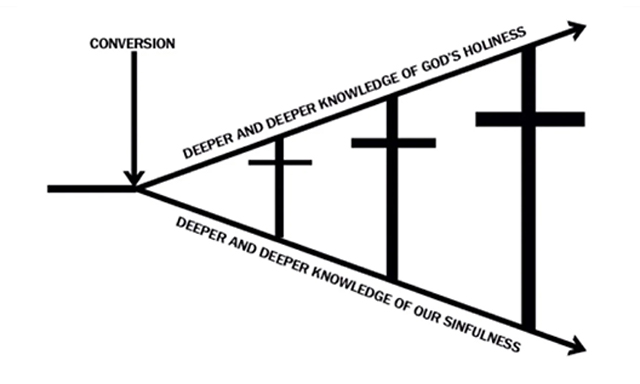
This growth happens as God’s glory and greatness are magnified and we are more convicted of our depravity. There is a chart from the study, The Gospel-centered Life, that illustrates this well (image at the top). It shows that as we have a deeper knowledge of God’s holiness and a deeper knowledge of our own sinfulness, it also makes the problem greater. The gap between ourselves and God only gets bigger. This also means that Jesus’ work to justify us and bring us back to God also grows. Our understanding of grace scales with our view of God and ourselves.
The way to experience grace in a greater way is not to stare at the cross and hope it grows. It is to read the Bible to learn more about God – to allow it to read you. It is about coming to God in prayer, confessing your sin to the just and the justifier. It is about walking with others to see God extending His grace to them. It is about coming together as a church family to partake in the sacraments and to retell the story of redemption over and over again.
In all of this, the Spirit of God, present in the heart of God’s people, will illuminate these seemingly small efforts, transforming them into sanctification and growth. Don’t be satisfied with a cheap grace or a gospel that makes you feel better about yourself, let yourself be confronted by the otherness of the eternal. Then, with the Psalmist, dwell on the question: who am I that you are mindful of me and care for me? (Psalm 8:4)